![[object Object]](https://customer-assets.emergentagent.com/job_ad7f6990-3079-4f1c-8fab-5bd4ddca75e6/artifacts/3w4b7wam_IMG_2303.jpeg)
Comuna 13 is probably the most visited neighbourhood in Medellín. It's also one of the worst-seen: plenty of people arrive, ride the escalators, take the photo of the mural they saw on Instagram, and leave without having understood anything.
This piece is about how to see it, not about whether you can. If that's the question you came with, we answer it separately and without decoration: is Comuna 13 safe?. And if you want the practical facts — how to get there, opening hours, what's there — they're on the Comuna 13 page.
This is about the experience.
First thing to understand: it's a mountain
Comuna 13 isn't flat. It's built on a steep hillside, house stacked on house, and that geography explains everything: why the streets are staircases, why one family's roof is another's patio, why the view from the top is so good.
It also explains the visitor's practical problem. Getting there from the rest of the city means climbing; and once you're up, there's a lot of walking. Plenty of people arrive already tired and do half the route.
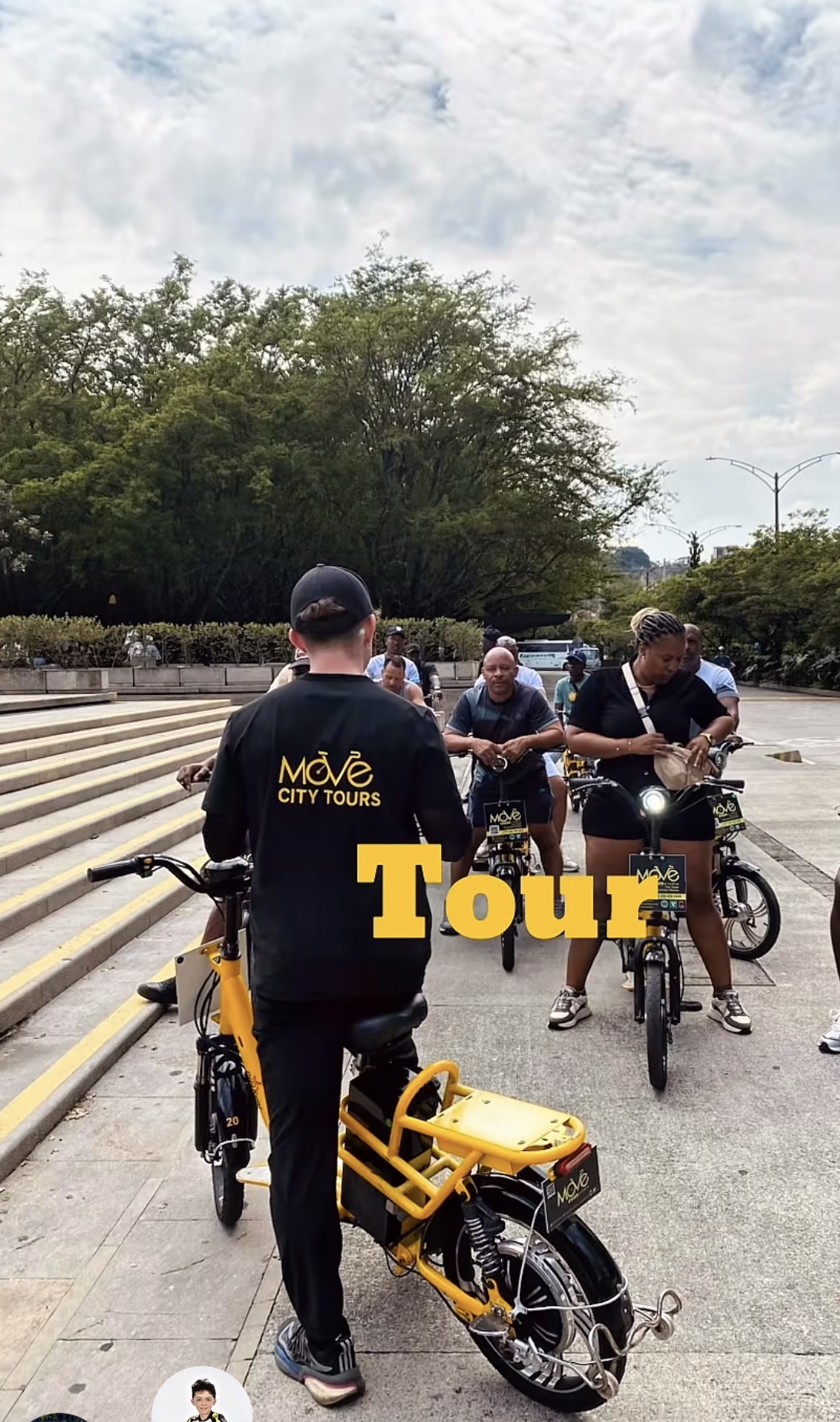
On an electric bike that changes. The approach — the long, hot, charmless part — is handled by the motor. You arrive with fresh legs exactly when the part that deserves walking begins.
The graffiti isn't decoration: it's a language
It's easy to see the murals as backdrops. They're something else.
In Comuna 13, graffiti grew as a way of telling what happened when there was no other way to tell it. Some murals speak about specific people, specific dates, specific absences. Others are pure colour and neighbourhood pride. And many get painted over, because these walls are still in use: they aren't a museum, they're a medium.
That's why it helps to go with someone who can read them. The gap between "that's pretty" and "ah, so this means that" is enormous, and it isn't written on any plaque.
The escalators: six flights that changed daily life
The outdoor escalators, opened in 2011, are the neighbourhood's best-known image, and they're usually told as a tourist curiosity. They aren't.
Before them, getting to the upper part meant hundreds of steps. For an older resident, for someone carrying groceries, for a mother with a small child, that was the whole day. The escalators turned an exhausting climb into a few minutes.
This is public infrastructure built for the residents; tourism arriving afterwards is a consequence, not the purpose. It's worth riding them knowing that.
The viewpoints: the city from the west
As you climb, the terraces open up. From the upper part you see the western side of the valley and, on a clear day, a good part of the city.
It isn't Medellín's widest panorama — for that there are other spots, gathered in the best viewpoints by electric bike — but it's the one you see from inside a living neighbourhood, laundry hanging, music next door. It's a different kind of view from a tourist lookout.
The music: the hip hop isn't background
You'll hear rap. A lot of it. And it isn't a playlist put on for visitors.
Hip hop in Comuna 13 is a real scene, with crews, with history, and with a concrete role: for years it was how young people told their own story and kept themselves occupied with something of their own. The breakdancers you see on the platforms aren't a hired attraction; they came out of this place.
If you like music, this is the part of the route most worth stopping for.
About the neighbourhood's transformation
One paragraph, without epic and without morbid curiosity.
Comuna 13 lived through very hard years of urban violence, and the whole city lived them with it. What you'll see today is what came after: public investment in mobility, community organisation, and a generation that chose to tell its story through art rather than let others tell it for them.
Residents will talk about it naturally if it comes up, but they don't come to work to be asked about it all day. The respectful way to visit is this: come to see what the neighbourhood built, not to hunt for the remains of what it suffered.
What the ride is actually like
In practice it works like this: the bike covers the journey from the city and the approach to the neighbourhood, which is where the hard climbs are. Once in Comuna 13, much of it is done on foot, because the streets are staircases and because you need to go slowly to look.
So the bike doesn't replace the walk — it leaves you with the energy to do it. And it solves parking, which up there is a headache.
The route is done with a local guide. That isn't a safety matter — more on that below — it's that without someone explaining the murals, half the neighbourhood goes over your head.
Practical tips
- Go mid-morning or mid-afternoon. At midday the sun on the platforms is fierce and there's nowhere to shelter.
- Comfortable shoes, no exceptions. Even arriving by bike, inside you walk and you climb steps.
- Bring small bills. There are food stalls, ice lollies, crafts and art by neighbourhood artists. Buying there is the most direct way for your visit to count for something.
- Ask before photographing people. The murals are public; the residents aren't.
- Water. The climb dehydrates more than it seems.
On safety, in one line
Comuna 13 is visited every day, with institutional presence and a community that lives from tourism and looks after it. The sensible approach is to go with a local guide and in daylight, which is exactly how we do it.
Not out of fear: because it's a neighbourhood, not a theme park, and moving well through a neighbourhood means knowing it. We cover it fully in is Comuna 13 safe? and in the safety guide for visitors.
If you want to do it with us
Yes, it's our tour, and we're telling you straight so you can decide with the full picture. What we add is the part that doesn't solve itself: the bike that saves you the climb, and a guide from here who knows whose mural is whose and why it's there.
Message us on WhatsApp and we'll sort it out.
Ready to experience it?
Discover Medellín on an e-bike private tour. Local guides · Instant confirmation · 5.0 ★ (350+ reviews).